Sunday, October 03, 2010

Siddharth Varadarajan, the speed reader!

Cometh the time, Cometh the man. Its Siddharth Varadarajan (Siddha Anartha) again. As a posterboy of Chindu, he never fails to deliver. These days he seems to be working overtime after having probably taken lessons in rapid reading. You can find his article here. Same link:
http://www.hindu.com/2010/10/01/stories/2010100163711400.htm

We request Siddharth (Siddha Anartha) to give us the address of the school from where he took the speed-reading classes so that we can digest the Ram Janam Bhoomi jugdement delivered by the Allahabad (prayAgam) High Court and get an "understanding" of it as he has. As we are lesser mortals (yet, i.e. not yet done the speed-reading class), we seek to understand Siddharth (Siddha Anartha) in his own words and attempt a humble analysis of the same:

The Lucknow Bench of the Allahabad High Court has made judicial history by deciding a long pending legal dispute over a piece of property in Ayodhya on the basis of an unverified and unsubstantiated reference to the “faith and belief of Hindus.”

Faith and belief of the Hindus need "verification and substantiation", while the faith and belief of those people who burn transport buses in Bangalore to vent their anger against some cartoons drawn in Denmark need no "verification and substantiation". Siddharth's (Siddha Anartha's) silence about (i) The Danish cartoon issue, (ii) The destruction of Bamiyan Buddhas (iii) The imposition of restrictions against films and film songs in Swat province by bigoted Taliban, (iv) The imposition of similar restrictions in Afghanistan by Taliban during their regime (v) The killing of women by stoning on frivolous charges of adultery in Iran (vi) The bigotry of the Saudi Arabia in not permitting anyone entering its territory from having any religious symbols apart from Islamic - has been deafening. But then, Siddharth (Siddha Anartha) is a battle hardened knave.

The irony is that in doing so, the court has inadvertently provided a shot in the arm for a political movement that cited the very same “faith” and “belief” to justify its open defiance of the law and the Indian Constitution.

The "irony" of the Shah Bano case where the judgement of the apex court was upturned in the "people's court" is something that we should all forget. In Siddharth's (Siddha Anartha's) fantasy world, all these are at best inconvenient truths, best forgotten.

The three learned judges of the Allahabad High Court may have rendered separate judgments on the title suit in the Babri Masjid-Ramjanmabhoomi case but Justices Sudhir Agarwal, S.U. Khan and Dharam Veer Sharma all seem to agree on one central point: that the Hindu plaintiffs in the case have a claim to the disputed site because “as per [the] faith and belief of the Hindus” the place under the central dome of the Babri Masjid where the idols of Ram Lalla were placed surreptitiously in 1949 is indeed the “birthplace” of Lord Ram.

First of all, if you call someone as "learned", the least you can do is to respect their judgement. But then, hypocrisy is Siddharth's (Siddha Anartha's) second nature. Hindus do not even have a right to a faith that a certain place is the "birthplace" of Lord Ram. They have to take permission from Siddha Anarthas of today. For identity-less people, it galls to see other people asserting their identity.

For every Hindu who believes the spot under the central dome of the Babri Masjid is the precise spot where Lord Ram was born there is another who believes something else.
The census-man and psephologist in Siddharth (Siddha Anartha) had to speak out. He had conducted a nationwide survey to arrive at this "fact". We lesser mortals shouldn't question this.

But leaving aside the question of who “the Hindus” referred to by the court really are and how their actual faith and belief was ascertained and measured, it is odd that a court of law should give such weight to theological considerations and constructs rather than legal reasoning and facts.

The question of place of birth of a certain historical or mythical character can be a "theological" one. But for Siddhartha (Siddha Anartha), anything concerned with God (Theos) should be shunned. But then why should he lecture Hindus as to what should be their faith?
Siddharth (Siddha Anartha) is not only a master of law, but also a master of rapid reading that he could digest the thousands of pages of judgement in 2-3 days to come to a conclusion that the judges haven't considered "legal reasoning" and "facts". (I cannot resist the temptation of a ROFL here :D)

Tulsidas wrote his Ramcharitmanas in 16th century Ayodhya but made no reference to the birthplace of Lord Rama that the court has now identified with such exacting precision five centuries later.
This sentence stands testimony to the irresponsibility, corruption, and malice of Siddharth (Siddha Anartha). The least any journalist could have done is "verification and substantiation" (See above for his lecture to the judges on "verification and substantiation") of his facts. For the benefit of Siddharth (Siddha Anartha), let us ask him to read one doha from the rAmacharitamAnasa (we are sure that he hasn't even read a word of it, for if he had, a crore sins of his would have been washed away and he wouldn't have written such heinous anti-hindu propaganda):
1. taha kari bhoga bisaala taata gae kachu kaala puni.
hoihahu avadha bhuaala taba main hoba tumhaara suta..
"Having enjoyed extensive enjoyments there you [Manu and Shatarupa] shall, after some time, be born as king of Ayodhya; then, odear[sic] one, I will be your son." (matter in square brackets mine.)
rAmacharitamAnasa, bAlakANDa, doha 151, can be found in rAmacharitamAnasa published by giita press gorakhpur, pg 171. The same can be downloaded here. You may copy paste the following link alternately:
http://www.gitapress.org/BOOKS/1318/1318_Sri%20Ramchritmanas_Roman.pdf

2. avadhapurii raghukulamani rAu. beda bidita tehi dasaratha naaU..
In the city of Ayodhya thre ruled a king who was a jewel of Raghu's race. he was called dasharatha, a name which is familiar in the vedas. (rAmacharita mAnasa, bAlakANDa, chaupai 4 after doha 187).

We can multiply instance after instance where tulasiidaasa (Tulsidas) clearly states the city of birth of rAma was Ayodhya. But then, tulasiidaasa was not watchful enough to give the exact street address of rAma's janmasthaana because he didn't foresee the likes of Siddharth (Siddha Anartha) asking for "verification and substantiation" for the place of birth of rAma. In the absence of the exact street address, we can make Siddharth's (Siddha Anartha's) life easier by suggesting that the whole of Ayodhya is the place of birth of rAma and no mosque be kindly constructed there. Will the Muslims or Siddharth (Siddha Anartha) accept construction of a rAma temple just beside their mosque at Mecca?

The “faith and belief” that the court speaks about today acquired salience only after the Vishwa Hindu Parishad and the Bharatiya Janata Party launched a political campaign in the 1980s to “liberate” the “janmasthan.”
This is a disingenuous claim of Siddharth (Siddha anartha). When tulasiidaasa (to whom Siddharth[Siddha Anartha] seeks to impute the omission of the place of birth of rAma) wrote his rAmacharitamAnasa, he was following the movement of Vishwa Hindu parishad!!! So also the likes of kamban of drAviDadesha, kR^ittivAsa of va.ngadesha, pampa of karnATaka, and multitudes of others!!! Please see this link for a partial listing of different versions of rAmAyaNa:
http://en.wikipedia.org/wiki/Versions_of_Ramayana
This was only till the advent of the messiah Siddharth (Siddha Anartha), who seeks to disabuse the Hindus of the mistaken notion planted into them by the heinous Vishwa Hindu Parishad!!!

Collectives in India have faith in all sorts of things but “faith” cannot become the arbiter of what is right and wrong in law. Nor can the righting of supposed historical wrongs become the basis for dispensing justice today.

"Faith" cannot become the arbiter of what is right and wrong in law? But Chinese government's opinions should become an arbiter. We understand it Siddharth (Siddha Anartha). We remember your articles crying hoarse about the falling through of the foolish Iran-Afghanistan-Pakistan-China gas pipeline. Moreover, Hinduism (A recognised religion in the Constitution of India) is just a "collective" (something like a laughter club or an old men's club or a trade-union in a PSU). Siddharth's (Siddha Anartha's) condescension and contempt for Hinduism is clear from this. But then, what else can be expect to come from the Chindu's columnists?

One of the questions the court framed was “whether the building has been constructed on the site of an alleged Hindu temple after demolishing the same.” Pursuant to this question, it asked the Archaeological Survey of India to conduct a dig at the site. This was done in 2003, during the time when the BJP-led National Democratic Alliance government was in power at the Centre. Not surprisingly, the ASI concluded that there was a “massive Hindu religious structure” below, a finding that was disputed by many archaeologists and historians.

When ASI failed to toe Siddharth's (Siddha Anartha's) line, it is because the ASI survey was conducted during NDA rule. I think this is a serious charge against the ASI and the ASI may find it appropriate to file a defamation suit against Siddharth (Siddha Anartha). One is surprised that the "secular" Ulta Pulta Alliance (UPA) which has been at the helm since 2004 didn't influence the ASI to find something more "secular" under the janmasthaan. Tthe CPI(M) for which Siddharth (Siddha Anartha) and his newspaper (Chindu, or "The Hindu") has ample sympathy, were partners of the UPA till the Indo-US nuclear deal. They could have easily done the bidding of Siddharth (Siddha Anartha) and forced the ASI to find something "secular".

The territory of India — as of many countries with a settled civilisation as old as ours — is full of buildings that were constructed after pre-existing structures were demolished to make way for them. Buddhist shrines made way for Hindu temples. Temples have made way for mosques. Mosques have made way for temples. So even if a temple was demolished in the 16th century to make way for the Babri Masjid, what legal relevance can that have in the 21st century?
This is another malicious charge that Siddharth levels against Hindus "Buddhist shrines made way for HIndu temples". When the communist historians have been challenged time and again to come up with a shred of evidence to support this claim, they have drawn blank. The understanding that they want the people to gulp down unquestioningly is very clear: "Now, come on!!! Everyone has been destroying every other temple in history, what is the big deal in it? Accept this and move on with life". When overwhelming proof from Islamic chroniclers are presented to them, we get deafening silence. If Siddharth (Siddha Anartha) is so concerned about Buddhist shrines, why doesn't he start a movement for restoration of Buddhist temples? Why doesn't he start by writing a few kind words about the Buddhist regime of Tibet which has been forced to live in exile in India? Why doesn't he write a few kind words in support of the Buddhists who are facing demographic change in Tibet because of settlement of thousands of Han Chinese? But then, he isn't serious about this, he wants to score a rhetorical point with a "suppressio veri suggestio falsi".

We request Siddharth (Siddha Anartha) to kindly come up with a scholarly rebuttal to the book "Hindu Temples What happened to them". For his benefit, we give the link to the online version of the book in two volumes:
http://voi.org/books/htemples1/
http://voi.org/books/htemples2/
The above book gives evidence from Islamic chroniclers about thousands of Hindu temples which were destroyed by political Islam. For his part, Siddharth (Siddha Anartha) may also kindly produce for us evidence about "Buddhist shrines made way for HIndu temples". We hope he won't disappoint us. For Siddharth's (Siddha Anartha's) kind attention, we quote here the statement of a non-Hindu, non-VHP historian, an American historian, Will Durant:
"The Islamic conquest of India is probably the bloodiest story in history. It is a discouraging tale, for its evident moral is that civilization is a precious good, whose delicate complex of order and freedom, culture and peace, can at any moment be overthrown by barbarians invading from without or multiplying within."
We can wake up sleeping people, but not people who keep pretending to sleep.

Siddharth (Siddha Anartha) has probably learnt the art of pre-emptive attack that his Chinese mentors follow. Hence he comes up with another gem:
And if such demolition is to serve as the basis for settling property disputes today, where do we draw the line? On the walls of the Gyanvapi mosque in Varanasi can be seen the remnants of a Hindu temple, perhaps even of the original Vishwanath mandir. Certainly many “Hindus” believe the mosque is built on land that is especially sacred to them. The denouement of the Babri case from agitation and demolition to possession might easily serve as a precedent for politicians looking to come to power on the basis of heightening religious tensions.
Yes, Siddharth (Siddha Anartha), you will hear soon from us (the awakened Hindus). We aren't asking for too much, we are asking for 3 temples (two more now) out of thousands destroyed by Islamic bigots (Not very much more bigoted than you. You are an intellectual iconoclast, they were and are physical iconoclasts. Both of you have a visceral hatred of Hindus and Hinduism.)

Even assuming the tainted ASI report is correct in its assessment that a Hindu temple lay below the ruins of the Babri Masjid, neither the ASI nor any other expert has any scientific basis for claiming the architects of the mosque were the ones who did the demolishing.
This is Siddharth (Siddha Anartha) at his poetic best. Ooooo... he is being too irresistible here. See, how even-handed he is (he is actually granting that the ASI report may be correct, albeit rhetorically)!!! The architects of the mosque didn't do the demolishing, they got labourers to do it for them. By this logic, they didn't build it either. The mosque wasn't built by the "architects". It was the wily Hindus who brought up a structure resembling a mosque so that they could beat the s***t out of the muslims centuries later. Another ROFL moment. So, Siddharth (Siddha Anartha) surely has a humour bone in the right place. Only that his humour is turning out to be more of a farce these days.

Saturday, October 02, 2010

CWG fiasco is Nehruvian socialism's dirty secret

The widespread publicity received by the CWG mess has drawn equally diverse responses from across the globe. A common emerging thread seems to be the loss of national pride even among those who otherwise consider nationalism a dirty word. As if it were not quaint enough, there is a palpable--though hitherto non-existent--sense of embarrassment and shame at the way soiled linens from the CWG complex were splashed across the web.

Such curiously misplaced sense of national honor and public dignity is quite baffling. Though several facile excuses have been served to reclaim spent glory, the CWG rot being a function of birth pangs seems to possess most takers. Sadly, even those more restrained and detached from the "Yippee" exuberance are nonetheless tarred by this phenomenon. Once international interest subsides and foreign teams return, court historians and Delhi sultanate's mandarins will declare victory and head home--TV studios and broadsheet pages that is. It is precisely why there now is a serious urgency to decouple national pride from the success or failure of CWG.

While the perceptive causes are 'Jugaad' and 'chalta hai,' themselves a bastard progeny of the protectionist era, the root cause is Nehruvian socialism, the lifeblood of protectionist tendencies. The dynasty's patriarch bequeathed the country with a deadly ideology and a moribund culture that wiped out the dignity attached to responsibility and enterprise. In pandering to the lowest common denominator of a newly unshackled populace, it offered a numbingly false sense of security that rested in continuation of a stolid status quo. With mediocrity thus metastasized, and then duly lionized by his daughter Indira, it was only a matter of time before the bills came due. That inception has now engulfed the nation, and will perhaps consume it, if it hasn't already.

Whatever the outside chance for salvation, lies within. The culture of grievance and sleaze will need to make way for a public hunger for merit, accomplishment, and recognition. Whoever manages to fire the imagination of a sulking public in some such way will have a wonderful job waiting for him...or her.

Friday, October 01, 2010

Neena Vyas's rancid reporting

Neena Vyas is evidently frothing at her mouth over the Ayodhya issue. She is letting out all the bile in her stomach through some acidic articles on BJP by freely mixing news with rancour.

In the below articles on Ayodhya, it is hard to distinguish where the news ends and her personal opinions begin. She takes it up as her personal agenda to discredit BJP's statements. So instead of reading BJP's press release, we end up reading Neena Vyas's personal opinion on BJP's statement. Contrast this with how Brinda Karat's views are reported.

The Hindu : Front Page : We now have answer for critics of Ram temple plank, says BJP

The Hindu : News / National : Advani sidelined on Ram temple issue
Hat tip to XR.

Romila Thapar questions ASI's professional expertise

Our eminent historian is quickly off the blocks. Romila Thapar questions the professional expertise of Archaeological Survey of India. On what basis? Heck, how dare you question the "eminent historian"!
It is immaterial that Romila Thapar became an "eminent historian" of early India without having any knowledge of Sanskrit. Her understanding of ancient India, its language, history and culture is based not on primary sources but interpretations and translations. Talk of professional expertise, pot, kettle, black...
The Hindu : Opinion / News Analysis : The verdict on Ayodhya: a historian's perspective
The excavations of the Archaeological Survey of India (ASI) and its readings have been fully accepted even though these have been strongly disputed by other archaeologists and historians. Since this is a matter of professional expertise ...

Thursday, September 30, 2010

Ace Chinese apologist

M.K.Bhadrakumar is clearly trying to be the ace Chinese apologist in People's Daily of China. If recent history is anything to go by, China has been provocative with respect to India. It is a real pity that this former diplomat sees the hand of American arms manufacturers in India-China relations. Is this not paranoia about American imperialism.
The Hindu : Opinion / Leader Page Articles : The great game pantomime
Somehow, our gurus are missing out on the quintessence of history and diplomacy
The pity is, just the wrong people could exploit Mr. Singh's plain thesis: middlemen for American arms manufacturers.

N.Ram disappointed with verdict

It is not surprising that N.Ram gave more space to Khan's verdict and barely mentioned Sharma. Justice Sharma said that the masjid was built after razing down a temple. Inconvenient truth for N.Ram and so he buried it. But he cant seem to bury his disappointment at the verdict.
The Hindu : Opinion / Editorials : Intriguing compromise could work
At one level, from the standpoint of political morality, the verdict
could be viewed as partially rewarding those who placed the idol
overnight under the central dome of the mosque and those who in 1992
razed it to the ground.


cHindu forced to eat crow on Ayodhya issue

In what is a landmark decision the Allahabad high court ruled that the Babri masjid was built upon the ruins of a temple.
cHindu with its fearless leader(jackass) LiC and his sickular minions are forced to eat crow as the court basically dismissed all arguments that cHindu and its sickular media cohorts were claiming all along.
So in a show of useless defiance, LiC decided to wail on a technicality that the court decided to split the land among 3 parties.
ruled that that the disputed site is the birth place of Lord Ram and that the disputed building constructed by Mughal emperor Babar was built against the tenets of Islam and did not have the character of the mosque.

Monday, September 27, 2010

cHindu journalists to keep monkeys away during CWG

In a news article reported today, all the journalists from cHindu from LiC to Sidd V, Ananth K to Neena Vyas were hired to provide security for the CWG ;)
To keep monkeys away from the Commonwealth Games venues here, the civic authorities are now ‘deploying' langurs. The New Delhi Municipal Council (NDMC) has brought in 10 langurs for the same, an official said. The NDMC already has 28 langurs, which are used to scare monkeys in VIP areas of the Capital

In response cHindu langurs were already claiming how Chinese monkeys had better unions and pay structures than the Indian democratic setup.

Sunday, September 26, 2010

Jackass of the week - Suhasini Haidar

Read this article by Suhasini Haidar on the cHindu and you can reach your own conclusions on why she deserves this award.
Few snippets to help you..
At one level, the fears of China overrunning Pakistan to open a front with India may seem far-fetched, even hysterical. At another, it may be a much needed wake-up call for India to reassess its preparedness to counter an increasingly assertive Chinese military. At an entirely different level, New Delhi's alarm in the past few weeks could be most constructive if it ensures that India takes a closer look at its own role in the region, and why China is making headway with so many of our neighbours.

She goes on the usual stupid cHindu line that India is raising fear on mystical ghosts.
While many in India would see these projects essentially as aid to a needy neighbour, it is time to invert the prism and see them, just as we accuse China, as ways of increasing our footprint and extending our ambitions to a sphere of influence well beyond our land mass.

A profound revolution

Alan Rusbridger, in this interview, says that chindu still stands for "something" -- this "something" used to be "left-leaning" in the past; now it is "People's Daily of China". N.Ram and his minions have done lasting damage to the brand that it wont be easy to shake this image off. The people of India never forgave Nehru for folly on China and I don't think they will be any more accommodating with chindu.
Chindu's analysis is biased, the brand is tarnished and N.Ram is taking the loyal readers for a ride. Alan is making the right noises but chindu does not look like it is keen to listen. The communists, who are so fond of people's revolution, won't be liking this one.
The Hindu : Opinion / Interviews : ‘We are going through a profound revolution'
We ought to use the information that is out there now, and very widely available, and become aggregators and analysers. We ought to build on the brands that we have, while we have them. Great titles like The Hindu and The Guardian still stand for something and are a kind of viewpoint or set of values. I think it is important that we use that brand, and that community of readers who understand and want to be a part of that community.
If we establish the right relationship with our readers, we can create something which enhances our journalism and enables us to go on doing things that we need to.

Ayodhya is religious, not political now

Events provide an opportunity for us to reflect upon the changing trends, analyse the impact of the change and, where applicable, suggest constructive criticism. Ayodhya was a mass movement in 1990s and it is no less an emotive issue today. But a lot has changed over the past two decades. Swapan Da captures this in his article.
Ayodhya is religious, not political now : India : Swapan Dasgupta : TOI Blogs
The irony is that this New India is more religiously and assertively Hindu than ever before.
In the 1990s, Ayodhya was a political issue; today its importance is religious.
Vidya Subramaniam, on the other hand, uses it to spread some filth
around and indulge in Hindu bashing. There were a few other articles by
her on Ayodhya over the week. But they all have the same theme. Don't
bother googling for it.
The Hindu : Opinion / Lead : When caution becomes an imperative
While Muslims have consistently favoured judicial adjudication of the title dispute, the difference this time is the strikingly moderate tone adopted by the Hindutva parivar. Forget ratcheting up passions or revving into an overdrive on agitational or celebratory programmes, the Bharatiya Janata Party and its ideological mentor have consciously eschewed provocative postures.

Saturday, September 25, 2010

Surprising but true, China gets aid in the billions

There are many countries getting international aid from the various agencies, donor nations etc. Many of them are in desperate need to support and maintain local projects as a significant majority live in abject poverty. However China gets a few billion dollars every year in aid. Yup you read it right, f-ing China gets billions while swindling other nations.
Development aid is not always solely based on need either. Aid groups say China is an ideal place to try out projects, because the authoritarian government can expand successful ones rapidly on a large scale. But China is effectively robbing the poor by competing for grants, said Dr. Jack C. Chow, who was the lead U.S. negotiator in talks that set up the Geneva-based Global Fund to Fight AIDS, Tuberculosis and Malaria, a major funder of health programs. The $1 billion China has been awarded in grants from the fund could have paid for 67 million anti-malarial bed nets, 4.5 million tuberculosis treatments, or nearly 2 million courses of AIDS therapy in poorer countries, Chow said.

Next time someone praises China for its development efforts keep in mind where it gets some of the money from and how.

Blatant Israel baiting by cHindu

LIC and his minions in cHindu like Sidd Varadarajan have some common motifs when it comes to International affairs. Anything about Palestine should be supported and so should any action against Israel.
So when a bunch of Arab tinpot dictatorships decide to censure Israel for having nukes, a motion which was defeated, cHindu expresses its disappointment in the result.
The resolution expressed “concern about the Israeli nuclear capabilities,” while urging the Jewish state to join the Nuclear Nonproliferation Treaty and to open its nuclear facilities to IAEA inspection.


How about questioning the human rights practices in those Arab nations? Or the dismal conditions for immigrants, women and minorities there. That's an article which will rarely be written in the cHindu.

Wednesday, September 22, 2010

India tells Pakistan to f!&% off

In response to Pakistan's "resolutions" passed on J&K, India responded strongly telling that it had no locus standi in J&K. Finally showing backbone the Foreign ministry told
Pakistan should instead tackle the issues of constitutional safeguards, democracy, extremism, terrorism and human rights violations in the part of Jammu and Kashmir that was under its “illegal occupation.”

Also needling our beloved neighbor on its lack of support for human rights,
Crucially, Pakistan must fulfil its stated commitment of not allowing territory under its control to be used for terrorism directed against India in any manner. This would be an important contribution towards safeguarding the welfare of the people of J&K who suffer the consequences of terrorism fomented from across the Line of Control and the International Border,

This will not stop Pak from fomenting trouble, but hey its a nice start.

Tuesday, September 21, 2010

cHindu does not publish Hindu readers opinions in Babri masjid issue

This set of Letters to the editor is a small sample. But based on the names there is not a single Hindu reader who has any opinion on the Babri masjid issue. One can come their own conclusion on the newspaper's fairness.

Only India - CWG funny pic

This is a pic from the footbridge connecting the CWG Stadium which collapsed yesterday.

Note the large number of policemen idly standing around, what are they doing? Protecting the debris perhaps?
Union Minister Jaipal Reddy said "it a small problem."
Yup 27 laborers getting injured and National pride getting damaged in the process is a small problem.

Sunday, September 19, 2010

cHindu advises against obeying the law of the land

There are times a newspaper should know its limits and really read what it publishes. cHindu and its fearless leader LiC have no qualms of reading or understanding what they publish. Case in point this article advising Sri Lankan President Rajapakse to show compassion to Gen. Fonseka. To give a background, Gen. Fonseka was the army leader who lead the dismantling of the LTTE in northern Sri Lanka. His falling out with Rajapakse was public and brutally exposed the inner machinations of Sri Lankan Government. Fonseka was tried and found guilty by the military courts of Sri Lanka.
The second court martial of Sarath Fonseka, Sri Lanka's former Army commander, has ended predictably with a verdict of guilty on the charge of violating procedures in military procurement. Last month, he was convicted of engaging in political activity while being in office. As punishment, the military court then handed down a dishonourable discharge, stripping him of his rank and all medals he had received in his 38-year career as a soldier. This time the court has recommended a three-year term in jail.

Now cHindu wants Rajapakse to forgive him and for what, show of magnanimity?
While there might be real doubts about Mr. Fonseka's integrity as a soldier, he remains a hero to large sections of Sri Lankans for his leading role in the nearly three-year-long military operation against the LTTE. Mr Rajapaksa stands to lose nothing by waiving the three-year jail sentence handed downto Mr. Fonseka. A pardon would only add to the president's political stature.

Really what next, Rajapakse should posthumous award a medal to Prabhakaran? This fight splits the Sri Lankan Government's rabid leaders of a state sponsored genocide apart and in the end is good for India.

Saturday, September 18, 2010

Accomodating hubris

The Hindu : Opinion / Lead : South Asia beckons China
As a senior Indian official put it “They [the Chinese] are a business-like people and they won't invest in that kind of area like that.”
I guess, our Nehruvian socialists still can't distinguish between economic sense and political sense. Reminds me of another famous exchange involving our first prime minister:
Nehru commented that "Not a blade of grass grows in Aksai Chin", attempting to explain that Aksai Chin was a barren, inhospitable land and the nation had lost little by its occupation by China. Tyagi retorted, pointing to his bald head: "Nothing grows here ..should it be cut off or given away to somebody else?".
The following paragraph illustrates why M.K.Bhadrakumar gets space in this Chinese daily.
In short, the rise in China's influence in the region can lead to peace and regional stability provided we eschew outdated notions of “sphere of influence.” On the contrary, a struggle will inevitably ensue if India chooses to contest China's growing influence since the quintessence of that choice will be that India is prepared to sacrifice peace and stability in the region in its quest for regional primacy. Our South Asian neighbours will only see our choice as a quest for regional hegemony and they cannot be expected to accommodate hubris.
A "sphere of influence" is a fairly generic concept. I dont quite understand when M.K.Bhadrakumar calls it an outdated concept. I wonder what has replaced it: a "cube of influence", may be?
It is ridiculous for M.K.Bhadrakumar to say that China's rise in influence can lead to peace and stability whereas India's can lead to conflict. To associate China's ambitions with peace and stability and India's ambitions with regional primacy and hegemony is playing mischief with words. It is preposterous for M.K.Bhadrakumar to suggest that India must accommodate hubris so that China's "peaceful" rise continues.

Wednesday, September 15, 2010

Muslim fundamentalism in Kerala

Panikkar says Christians are reinforcing the religious fundamentalism of Muslims. But he doesn't miss the opportunity to take pot shots at Hindus.
The Hindu : Opinion / Leader Page Articles : A victim of fundamentalism
Religious fundamentalists are on the rise among Muslims and Hindus.

Saturday, September 11, 2010

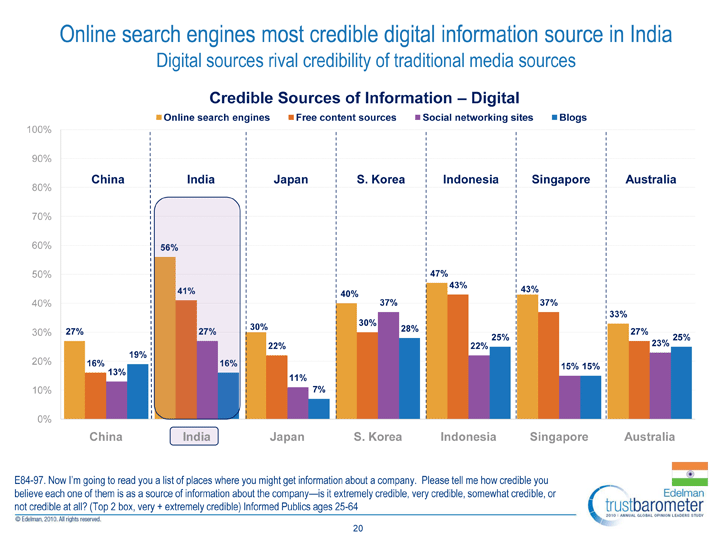
Falling trust in media

There is the ongoing onslaught of electronic media, but what will eventually come to haunt the mainstream media more than anything else is the growing trust deficit.
Each of the consumption patterns, including electronic media, has a distinct identity wrapped around consumer lifestyle. The newspapers survived and flourished even while television was entrenching into the consumer lifestyle. The print and television media will continue to appeal to people even while electronic media claims its fair share of consumer timespace. What is accelerating the adoption of electronic media is the growing distrust in mainstream media. One particular trend of interest is the number of people adopting the electronic lifestyle by disowning the mainstream media. Having to verify what is being written in print media, or spoken on television, is an additional burden the consumer can get away with by relying on the electronic format. This trend points out that Indians are spending time digging for truth.
The traditional media outlets are not doing themselves any favour by trying to do even better what they have always been good at -- corruption. Take this article, for example, where the bit about incest in mythology was lifted verbatim from a pakistani forum indulging in hate speech. It makes one wonder if ToI really cares about its reader or its own image. Such journalistic ethics leaves consumer with no choice but to dump the mainstream media and switch to electronic sources.


Hat tip to B.Shantanu. (Link 1, Link 2)

Thursday, September 09, 2010

cHindu welcomes alliances with despotic nations

In what is a clear exhibition of lack of vision or even rabid insanity, cHindu reiterates its vision for India to have close friendly diplomatic ties with nations like Pakistan, Russia, Tajikistan while warning against ties with democratic nations. It laments the fact that India was not invited to a tea party organized by four nations which had a little get together and did not invite India.
However the author does not realize that the whole exercise while touted did little in actual value.
In Sochi, Mr. Medvedev renewed Russia's offer to rebuild about 140 industrial and infrastructure projects in Afghanistan, which the Soviet Union set up during its 10-year military intervention. The deals may be worth over $1 billion, and may entail further Russian investments in Afghanistan's oil, gas and minerals. Russia's comeback will also encourage many of the 2,00,000 Soviet-educated Afghans, who fled the Taliban to Russia, to return to their homeland.

There were no deals signed and even if realized the value is quite small. The whole NATO investment is about 50 times that amount spent every month.
Of course no Vladimir Radyuhin being the usual Ruskie stooge takes potshots at the US stating,
The Barack Obama administration has “a regional strategy for both Afghanistan and Pakistan, and Russia can play an important role along with other countries in the region,” Assistant Secretary of State Philip J. Crowley was quoted as saying in a comment on the Sochi summit. Russia is giving considerable support to the U.S. in Afghanistan in line with the broader “reset” in their bilateral ties, but Washington of course is overly presumptuous to think that Moscow will toe its “strategy” in the region, assuming, of course, that the White House has one.

Long story short, the author's POV that this meeting is like the second coming of Magna Carta is simply ridiculous and any Indian diplomat reading this would laugh it off. There is probably significant value for India to discuss with the individual nations separately and sign agreements than deal with all these monkeys together.

Wednesday, September 08, 2010

The failed communist state

The communists, who keep showcasing the paradise that is Cuba and its demigod Fidel Castro, must be crestfallen to hear that the Cuban model doesn't work. I hope the comrades in chindu realise the falsity of this ideology and take course correction. I know, I know. How about chindu stops giving disproportionate amount of coverage to Cuba and Castro.
The Hindu : International : Cuban model doesn't work: Castro
Mr. Castro replied — “The Cuban model doesn't even work for us anymore,”

China willing to work with India for South Asia peac

given the nature of conflict and the context within which the statement was made, manmohan's call to confront china's territorial ambitions should have made it to the front page verbatim. instead, n.ram uses his editorial judgement to send a message which is contradictory. this is worse than appeasement. it is a clear indication that chindu is being run from china.

---------- Forwarded message ----------
From: Xinhua Ram

India's PM says China's territorial ambition must be challenged
Beijing has funded a number of strategic roads and deepwater ports in these countries, known as the "String of Pearls"

So far this is yet to be reported by People's Daily of Chennai. For them, only Peace and Good Intentions radiate from that land to all corners of the world:
China willing to work with India for South Asia peace

Sunday, September 05, 2010

A sophisticated anti-occupation resistance

N.Ram's suggestion is a lot more relevant to Tibet than Iraq: Tibetans must develop a sophisticated anti-occupation resistance against the Chinese or risk being wiped out by the ongoing genocide. But his ideological disposition and his allegiance to his Chinese masters wont let N.Ram spell out such a thing. Instead he makes the usual war cries against American imperialism.
The Hindu : Opinion / Editorials : Meaning of withdrawal
The Iraqis now have a hard choice: either surrender to Washington's diktat and witness the emergence of their country as a full-blown American satellite state in the heart of West Asia, or revive at all levels a sophisticated anti-occupation resistance that steers clear of al-Qaeda terrorism and Iraq's sectarian fault lines.

Friday, September 03, 2010

Imaginary threads to weave emperor's clothes

In another case of truth by repeated assertion, we have Vidya Subramanyam telling us about the incident of a catholic nun raped in Kandhamal. The media ran the story of Jhabua nun rape case endlessly until the truth emerged that the perpetrators where christians. But that is no deterrent for Vidya, the bleeding heart intellectual. She repeats in gory detail the rape incident even though it is now public knowledge that the alleged rape was a fabrication. She is imagining all these common threads and creating a fabric to dress the emperor with no clothes.

Vidya Subramanyam now joins that non-state actor, Arundhati Susan Roy, in the liar club.
The Hindu : Opinion / Op-Ed : Three pogroms held together by a common thread
The Hindu of September 30, 2008 reported the case of a Catholic nun who was stripped naked and brutally gang-raped in front of a police post with 12 policemen from the Orissa State Armed Police present and watching. The Catholic priest who was with her was mercilessly thrashed for refusing to participate in the atrocity.

Here is the Sep 30, 2008 report filed by Parvathi Menon, which made it to the front page of chindu:
The Hindu : Front Page : Nun was gang raped and priest brutally assaulted in Kandhamal
The gang rape of the young nun, whose “virginity [was] grossly violated in public” ... took place in front of a police outpost with 12 policemen from the Orissa State Armed Police present and watching, according to Father Thomas Chellan, the priest who was dragged out and badly beaten.

“Around 1 p.m., a gang came and pulled me and the Sister out of the house where we had taken shelter and started assaulting us,” Father Chellan told The Hindu in a telephonic interview from Kerala where he is recuperating.

“My appeals to the policemen who were standing nearby and watching only resulted in further beating. At one point the nun slipped away to plead with the police for help but she was dragged back by the mob and her blouse torn,” he said. The nun was gang raped in a nearby building, and he was doused with kerosene by the mob, which threatened to set him on fire. They were saved by a group of youth who took them to the police outpost where “one among the attackers was present with the police between 3 p.m. and 9 p.m.,” Father Chellan said.

News of the K. Nuagaon atrocity was conveyed through mobile phones to several priests and nuns hiding in the forests, fearing for their lives as the anti-Christian hunt was on. The victims were taken to the Baliguda police station around 9 p.m. where they lodged First Information Reports. “I believe the Sister wrote in her complaint that she was raped,” Father Chellan said.

Vidya Subramanyam is probably well aware of the direction in which the case is going but she avoids referring to a more recent update on the case. Below is 27 July 2010 news item from chindu hidden in the Other States - Orissa section:
The Hindu : Other States / Orissa News : Nun rape case: priest deposes before judge
Baliguda Catholic church Father Thomas Chelathin—a key witness to the Kandhamal nun rape case, admitted before a trial court here on Monday that he had not mentioned about the rape incident in his first FIR filed on August 26, 2008, just a day after the nun was allegedly raped during the communal riots in the district.
But to get a really good idea, read Sandhya Jain's article on Daily Pioneer, dated August 3, 2010. Link and Excerpts below:
The Pioneer > Online Edition : >> A conspiracy unravels
Fr Thomas Chellan’s admission in court on July 26 that he did not report the alleged rape of the nun when filing the first information report with the police on August 26, 2008. The Baliguda Catholic Church pastor, a key witness in the case, admitted during cross-examination before Cuttack district and sessions judge Bira Kishore Mishra that he had not mentioned the alleged rape in the FIR filed a day after the incident is said to have occurred. His complaint caused the arrest of 23 people.
He identified two accused in court as being part of the mob that attacked his church, but had failed to identify either man during the test identification parade held at Choudwar jail last year.
Interestingly, Dr Chotray Marandia, who first treated the nun after the alleged assault-cum-rape, testified on August 28 that she had only complained of swelling on her face. “I only treated the swelling on her face and she did not complain of anything else,” he replied when asked by defence lawyers about other injuries on her body. So we have no evidence of rape.

The then block development officer, Mr BB Mishra, testified that he had accompanied the nun and priest to the local police station to file their complaint about the mob attack. Both thus had full official protection while filing the complaint, and cannot claim that the police did not record the FIR properly, or that the rape charge was ignored by the police. These testimonies are damning.

That the rape is most likely a fabrication can be seen from the nervousness of the prosecution. Earlier, her lawyers had sought a month’s time for the nun to appear before the court. This is suspicious to say the least, but fits in with the church’s hiding the nun from the local people and producing a veiled woman with a thick Malayalam accent at a Press conference in Delhi. Interestingly, last Saturday the nun failed to identify the key accused at a test identification parade.

The Church-prosecution embarrassment has been aggravated by the June 12 arrest of Pandit Bishimajhi for allegedly plotting to kill the nun and priest to prevent them from testifying against the mob. It was alleged that Bishimajhi led several mob attacks, one of which stripped and paraded the nun and Fr Chellan, and is thus complicit in the fast-disintegrating rape case.

Sunday, August 29, 2010

Kashmir's economic dependence and trust deficit

The Hindu : Opinion / Leader Page Articles : Kashmir: youth bulge, peace deficit
The
foundations of an abiding peace will be laid not by words but sickles
and hammers; in farms and factories; by concrete and steel.
This is the kind of rotten justifications the sickle and hammer needs. On second thought, it might not be a bad idea to scrap article 370, pack all the communists and settle them in Kashmir so they can plant the sickle and hammer.

Praveen Swami bases his argument on the dependency ratio and economic opportunities. In 1987, Srinagar and Sopore had higher than normal dependency ratio. Without access to more detailed statistics, I can hazard a guess here. Such short-term, local imbalances can be expected. And Srinagar and Sopore are not the only places where it ever occurred. In other words, taken over a longer period of time and geography, Kashmir is not different from the rest of the country, which interestingly is reaping it as a geographic dividend. As it is often said, there are lies and bigger lies and then there is statistics. Praveen Swami is choosing his data for statistical analysis carefully.

Secondly, there is the other important aspect of what Praveen Swami is trying to hide from the readers. Kashmir is more prosperous than the rest of the country and it is bleeding India dry. It is time to ask, apart from terrorism what has been Kashmir's contribution to India. This is the time to stop appeasement of a violent minority.
J&K's dependency on Centre alarming - India - The Times of India
In 2009-10, J&K received Rs 13,252 crore as grants from the Centre, which constitutes nearly 60% of the state's total expenditure. In fact, for the past two decades since the separatist movement spread in the Kashmir valley, the centre has been propping up the state through similar doles. In all, J&K has received grants amounting to Rs 94,409 crore between 1989-90 and 2009-10.

For over a decade, from 1994-95 to 2005-06, the state received 10-12% of all grants disbursed by the central government to the states. In 2009-10, this proportion had dipped slightly to about 8%. This is way above J&K's share of India's population, which is a mere 1%.

Wednesday, August 18, 2010

Varadarajan's Questionable Nuclear Liability Claims about South Korea and Hungary

With the report of the Parliamentary standing committee recommending a change to the controversial clause 17(b) of the Civil Nuclear Liability Bill (my thoughts on the committee report can be read here), Siddharth Varadarajan has already fired his opening salvo against it today in this so-called news item. I say so-called because the author's sentiment comes across plainly in the text.

I have explained the issues with this provision in earlier posts (see here, here and here) and will not repeat them here. In support of his view that India ought to have retained that provision, he claims that "Globally, South Korea and Hungary provide the operators with a right of recourse against the suppliers in the event of gross negligence, regardless of whether or not the contract provides for it or not." As far as I know, this is simply not true - in my previous post, I had explained the position taken by the South Korean law which allows the contractual arrangement between the parties to prevail over the default position laid down by the enactment. Hungary is a signatory to the Vienna convention which explicitly limits the operator's right to recourse (under article X) if expressly provided by contract or the incident resulted from the act or omission done with intent to cause damage, i.e. in other words, provisions equivalent to cl.17(a) and cl.17(c) in the Indian bill.

Another Independence Day for our enslaved media

Manmohan Singh and Sonia Gandhi get the credit for their leadership; the congress and the government, although under the same leadership, gets blame for corruption and ills. The disclaimer about the reputation of Manmohan and Sonia, who are lording over the rot, being intact is and indication of the extent of sycophancy.

Another Independence day has come and gone but these journalists can't seem to liberate their enslaved minds. They wonder at allegations related to CWG but can't come to terms with the level of corruption in their minds.

The Hindu : Today's Paper / OPINION : A Peepli Live Independence Day
The UPA-I's biggest asset was its leadership. Dr. Singh and Sonia Gandhi stood for decency in public life. Their reputations are still intact but a discomfiting odour has come to surround the government and the party they run. And there is a cocky arrogance about both. Nowhere is this more apparent than in the way the Congress and the government have brazened out allegations of corruption in the Commonwealth Games.

The Prime Minister has intervened at a time when it is common knowledge that thousands of crores have already gone into the bottomless CWG pit.

Sunday, August 08, 2010

Fall of communism in China

How do autocratic countries collapse? History has always shown that the guiding principle of autocracy to subdue alternative philosophies and remove influential thinkers fails in the long run with the various subdued groups taking power often with violent force. China is currently in the same situation. The rabid growth of Islam and the underground churches sprouting like mushrooms have left the Government fighting to put down these groups. cHindu in this series by Ananth Krishnan attempts to do a circus act detailing the problems faced (or created) by the Uighur Muslims while detailing the opposition (help) provided by the Communist Govt.
The Chinese government has, however, blamed exiled separatist groups — as well as some local religious leaders — for fomenting the recent unrest. It has since launched a campaign against “the three evils” — terrorism, separatism and religious extremism. Xinjiang's mosques — and its worshippers — are now on the government's radar.

As usual the Uighurs blame the Government for all their ills, as usual for not giving them money or development priority and preventing them from practicing (spreading or violently converting) their religion.
The riots, Uighurs say, were the result of years of simmering tension between the two groups, exacerbated by what they see as Beijing's flawed developmental policies. The increasing migration of Hans has stirred local resentment; so have recent restrictions on local mosques. Uighur unemployment is on the rise, as is the income disparity between the two groups.

It will be interesting for India to see its neighbor China collapse slowly but surely and plan for the repecussions of what might happen in the future.

Wednesday, August 04, 2010

cHindu's new Kashmir analysis

A writer known as "Maa-loony" analyzes the Kashmir situation and provides her analysis in this Leader page article.
As usual she starts off on the wrong foot by blaming the security forces for the problem.
Heartrending spectacles of teenage boys defiantly hurling rocks at the police and paramilitary personnel and of mothers weeping besides the bodies of loved ones killed in the indiscriminate firing by the security forces, playing out daily on television screens nationwide, have jolted us out of our collective complacence as regards Kashmir.

Her analysis clearly paints this as a political issue and absolves the Kashmiris of all blame.
The protesters on the streets, apart from the teenagers, are educated doctors and MBAs, frustrated at the lack of employment and economic opportunities. It is not hard to see where the frustration of the educated Kashmiri youth comes from. On the one hand, they are told that they are Indian citizens but they are shut out of the narrative of India as an emerging economic power.

What she fails to realize is the intervention of our friendly neighbor Pak's role in this whole brouhaha as evinced by the WikiLeaks episode in their interests in controlling the region through support of terror groups. Her asinine repetition of Indi-Paki bhai bhai statement shows cHindu's Paki sycophancy and treasonous position on international affairs.
The moral authority of India's actions in the Kashmir valley will be strengthened by a demonstrable willingness to work with Pakistan to find a permanent solution to the dispute over its status. It will help in large measure to heal the wounds and the angst of the Kashmiri people who feel they are hostages to a larger geopolitical wrangling.

Saturday, July 31, 2010

cHindu request nominations for Best Fiction Award 2010

We the writers on this blog would like to nominate the following for the cHindu best fiction awards:
Best Paki-loving writer: Sidd V
Best Loony Judicial writer: Hon. Kris Iyer
and last but not least,
Best "Editor": LiC

Let us know who else should be nominated for the Fiction Awards :)

Wednesday, July 28, 2010

Digvijay Alleges RSS Received Funds From ISI!!

In case anyone was thinking this was from The Onion, it is not. This comes from Congress leader Digvijay Singh in an interview in the latest issue of Frontline:
"The same ideology and the same people can set up an organisation under a different name. The RSS itself has more than a thousand organisations. Similarly, the Lashkar-e-Taiba, too, has a front organisation that does charity work. It is the people behind this ideology – whether Hindu or Muslim – who have to be closely followed and investigated. For example, elements within the RSS itself have alleged that RSS chief Mohan Bhagwat and Indresh Kumar were receiving money from the ISI [Inter-Services Intelligence]. I am not alleging this. I think all these allegations should be closely investigated."[emphasis added]

Never mind the comparison of RSS with LeT, a favorite leftist trope these days but Mohan Bhagwat and Indresh Kumar receiving ISI funds? Is this a complete fabrication or is he repeating an allegation someone else made? Who exactly are these "elements with the RSS itself" that he refers to? It seems too wild and absurd to be worthy of comment but still, has the RSS said anything about this?

Tuesday, July 27, 2010

Turning a blind eye to the WikiLeaks release

In what can be termed as predictable by cHindu standards, the editorial Probe the policy, not the leak was quick to blame the US Govt's policy in Afghanistan and missed the bigger picture. India's interests of national security in the region lie firmly with a stable democratic Afghanistan which is unlikely to happen until Pakistan (and its ISI minions) stop interfering in the Afghan war by supporting the Taliban.
Wonder how long it will take Sid V and his boss LiC to talk about the real issue, how Pakistan is stabbing the US in the back while setting up India to fight the terrorists from Af-pak?

Sunday, July 25, 2010

NATO Withdrawal and the Fiction of Resolving Afghanistan through Diplomatic Conferences

The Hindu repeats its prescription for an immediate withdrawal of NATO forces from Afghanistan and an international conference leading to a pledge of non-interference in Afghan affairs along the lines of the July 1962 Neutrality of Laos declaration as the way forward. I repeat what I had written in an earlier post about why this suggestion is contrary to Indian interests in Afghanistan and why such conference pledges cannot be enforced and will bring neither peace nor stability to that state. One need look no further for proof than the Laos declaration itself which failed to halt the civil war in that country. The suggestion that such a declaration may "pave the way for an Afghan solution to nation rebuilding - one that will hopefully reject the Taliban" is bewilderingly naive and ludicrous. If the Taliban could have been stopped through declarations, it would surely have happened a long time ago.

The suggestion serves Pakistan's interests which has assiduously nurtured the insurgents as numerous reports including the most recent one in today's NYT make clear. A withdrawal of foreign troops may very well happen with the souring of the public mood in the NATO member countries but it would be a greater disaster if done precipitously as The Hindu asks for. Any definite departure date will only prepone the civil war which is likely to ensue in the aftermath. In fact, with Obama's 2011 drawdown date and the conference's aim to transfer all control by 2014, there are real signals that parties have begun to prepare for this eventuality.

This is not to say that attempts to reconcile the divergent interests of Afghanistan's neighbors and India should not be attempted but that hard task is not going to be made any easier by a withdrawal. Quite the contrary. This very difficult task may be, if at all, slightly easier with NATO troops still firmly entrenched in the region.

Presently, it appears that Pakistan does not perceive a democratic Afghanistan to be in its interests and believes it can prevail with the help of its proxies. Any solution to the conundrum must squarely address this perception either by altering it through diplomatic persuasion or by raising the costs of pursuing efforts towards this end. The former route has been the preferred choice but has yielded no results and besides a few drone attacks, there is little political support for the latter. At the moment, there is no real hope of a change in that deadlock which means the fate of Afghanistan will probably be once again determined in future by force. Hopefully, India too is preparing for a post-NATO Afghanistan. It remains to be seen whether India will go back to supporting the erstwhile Northern alliance along with Iran and Russia in any civil conflict or will attempt to find allies among the Pashtun groups this time.

Thursday, July 22, 2010

Mount Road declares independence from Chennai.

The International Court of Justice took a very radical decision when it upheld the separation of Kosovo from Serbia. This will probably lead to more states asking for separation.
The long-awaited ruling — which the court took up after a complaint to the U.N. from Serbia — is now likely to lead to more countries recognising Kosovo's independence and move Pristina closer to entry into the U.N. Kosovo's statehood is backed by 69 countries but it requires over 100 before it can join the U.N.
Announcing the decision, the Court of Justice President, Hisashi Owada, said international law contains no “prohibition on declarations of independence”. Though both Belgrade and Pristina had said they were confident of a ruling in their favour, speculation began to emerge a few hours before announcement in the Hague that the decision — which is not legally binding — had gone Kosovo's way.

The interesting words here - "Legally binding". Does that mean that me and my friends in Avadi or Thenkasi can apply for secession with the Hague and start printing Tam-rupee notes with photos of Monkeys and Politicians?

Monday, July 19, 2010

N.Ram exercises his 'free' speech

Kanchan Gupta wrote about how 'free' media is maligning the RSS. N.Ram needs no invitation to exercise his freedom. The secular investigators found that the Godhra train was gutted by spontaneous combustion. It would be surprising if these secular investigators did not find a way to lead the terror trail to the heart of the Sangh. But the one point everyone is carefully avoiding is educating us on Hindutva terror. What exactly does Hindutva terror mean? Who cares as long as it serves the political purpose of the establishment to crush the already weak opposition.
The Hindu : Today's Paper / OPINION : Hooliganism pure and simple
But equally, there is no denying that the Hindutva terror trail is inching towards the heart of the Sangh.

Sunday, July 18, 2010

N.Ram says burqa is oppressive

In what must be one of those rare moments when chindu says anything mildly critical of Islam, N.Ram says burqa is unquestionably an oppressive garment that seeks to keep those who wear it imprisoned behind a screen. Quick, print out copies of this and distribute it to the mullahs and those islamic rage boys who deliver instant justice.

N.Ram says burqa is oppressive, keeps those who wear it improsined behind a screen, backward looking, misogynist, antithesis of liberté, égalité, fraternité and against national motto of France. Phew! And the downside to banning the burqa is radicalisation of muslims. The argument against the ban is terribly weak. By allowing burqas, it is discouraging the integration of muslims into the French society and promoting ghettoisation, eventually leading to radicalisation. France better stand up for the humanitarian values that define its nation. N.Ram will of course never get to do that because he is an appeaser of islam.

The Hindu : Today's Paper / OPINION : To ban or not to ban
The burqa (not to mention the niqab) is unquestionably an oppressive garment that seeks, as Mr. Sarkozy pointed out, to keep those who wear it imprisoned “behind a screen.” It is nowhere prescribed in the Koran but has been imposed on millions of women by sections of the clergy — all of them male — who have interpreted religious texts to suit their backward-looking religious or political agenda. That many Muslim women seem willing to embrace the veil ... speaks more of their successful co-option in a misogynist project that is the antithesis of liberté, égalité, fraternité — values that go back to the French Revolution and are the proclaimed national motto of France.

‘Free’ media tars RSS with fiction

People complain of criminalisation of politics. But it could not have come to this stage if not for a greater criminalisation of media. Media is emulating such extraordinary standards of corruption that the politicians know they can wash away their sins even without a confession. In the present scheme of things, media is at the top of the food chain, having politicians for breakfast. At the bottom of the food chain are hindus. And when it comes to hounding the hindus, both the media and politicians gang up. Lets not get to the rabid dogs, the violent pigs and the unscrupulous hyenas.

The zealousness with which media followed the Sadhvi Pragya Singh case, the Kanchi Shankaracharya case, or Swami Nityananda case and the ease with which it brandished the label "hindu terrorism" is appalling. We have repeatedly pointed out on this blog how hindus have been demonised and how islamic violence has been justified. The media has equated freedom with absolute freedom with no accountability, and in reality, there is no one to cage this media monster.

The
Pioneer > Online Edition : >> ‘Free’ media tars RSS with
fiction

But what is objectionable is the attempt to
disguise biased writing and distortion of the truth as “freedom of
expression”. The ongoing campaign of calumny to demonise the RSS and
denigrate Hindus by painting the first as a sponsor of terrorism and the
second as a community of terrorists is by no stretch of the imagination
‘freedom of expression’. Nor does media have the freedom to malign or
defame individuals and then seek shelter in its presumed immunity from
scrutiny.

Had it not been so, our
‘free’ media, a large section of which thrives on ‘paid news’, would
have reported that the investigating agencies have failed to come up
with any evidence to make their charges against Sadhvi Pragya Singh
Thakur and Colonel Srikant Prasad Purohit stick. ... That it’s been two years since they were
arrested and have been in jail without being prosecuted or formally
charged.

Saturday, July 17, 2010

Naxalism is being thrust upon us

this is in response to mouly's comment on indian state being responsible for naxalism:
we do have our fair share of problems and people have different ways of responding to adversity. but it is interesting to note that naxalism originated in bengal in 70s when it was among the top few most prosperous states in the country. and it found resonance in andhra which was not in the bottom half in terms of state patronage, poverty or law enforcement. goes to show that naxalism did not germinate in state failure alone.

once the ideology found its roots, it is easy to see how naxalism spread to those parts reeling under anarchy but i wouldnt attribute naxalism to state failure within the indian context. equally, it is easy to see how naxalism could have been nipped in the bud had the state been strong.

but as XR has said, it is the marxists who tend to attribute the birth or naxalism to state failure. it appears as a lame excuse to justify their existence and their fight against the state itself. "you created me because you failed, so i am going to fight against you" is a poor justification. instead, "you created me because you failed, so i am going to compensate for your weakness" is a more constructive approach. the latter is representative of indian ethos. this is the reason why we see citizen initiatives where the state has failed miserably in providing basic amenities. this is the reason why we dont see a million mutinies a day like in china. naxalism does not have any basis in indian culture; it is being thrust upon us and is trying to find some legitimacy.

Thursday, July 15, 2010

Gratuitous advice from V.R.Krishna Iyer

The senile old man is back again, this time giving gratuitous advice on tackling naxalism. VR Krishna Iyer says the state failed, leading to extremism. So, when exactly did the Indian state failed? Did extremism exist before that point? Was there extremism even before the state came into existence? Why dont we link naxalism to emergency, when the Indian state did actually fail?

Wrong analysis can only lead to wrong conclusions. Getting into peace talks with naxals who refuse to put down their arms did not yield any results in Andhra Pradesh. Armed conflict with the state is now an intrinsic aspect of the naxal movement.

Finally, Swami Agnivesh is that useful idiot whom the Christist missionaries use for their subversive activities. No wonder VRK Iyer treats him as a darling.

The Hindu : Today's Paper / OPINION : An appeal to India's conscience
Inevitably, when the state failed the confidence of the people they took to the streets, to the jungle and to lawlessness. Terrorism was the next step, ubiquitously shaking up peace and the sense of safety and development. This is the genesis of Naxalism, Maoism and other forms of extremism.

Sunday, July 11, 2010

Selling Pakistan as India's friend

Coming back after a long absence, I'm not surprised to see cHindu becoming Pakistan's propaganda machine.
There were multiple articles portraying the epicenter of world terrorism as a friend of India starting with an editorial by LiC - China, India, and Pakistan
LiC states -
Presidents Zardari and Hu Jintao jointly pledged to fight the “three forces” of extremism, terrorism, and separatism. However, there was no official word from China on its nuclear cooperation with Pakistan, although it is definitely on the cards.

He goes on to defend China's track record with Pakistan stating,
It is true that the relations Pakistan has with China are the best it has with any country in the world. They have withstood the strain of shifting international relations for more than 60 years. However, it is by no means a problem-free friendship.

Perhaps providing one nation with nuclear weapons is indeed a deep act of friendship.
The next article is another love Pakistan article by Suhasini Haidar - Ending the zero-sum game. The entire article goes on to summarily state that Pakistan is a huge victim of terrorism claiming multiple attacks on minorities as examples. However the writer takes a passive stand ending the article with a vague statement,
eventually, it is only in Islamabad's realisation that working against the LeT and other anti-India groups is in its own best interests that would change the discourse from its unproductive past.

The next article Transnational terror needs cross-border cooperation - by Sandeep Dikshit and Anita Joshua. This is another apologist article wringing its hands that Pakistan's internal operations were tied down because of internal social problems prevent Pakistan from acting on LeT and JuD.
Even if there is actual cooperation, Hafiz Saeed remains an irritant and from what most security experts have to say, this will keep festering as Pakistan can ill afford to repeat a Lal Masjid. Explains Imtiaz Gul, author of The Al Qaeda Connection and Executive Director of the Centre for Research and Security Studies: “There are political and social compulsions; can we deal with the fallout in case Saeed is ‘harmed' in any way? We are still suffering the consequences of the Lal Masjid operation [July 10, 2007] involving a small group that has now resulted in the Ghazi Force. Taking on the LeT would probably result in far graver consequences [hence the tolerance, and reluctance to crack down on them]. How do you deal with the hundreds of thousands of students at Jama'at-ud-Da'wah [JuD] madrasas if they were to see the state coming down hard on them?

Perhaps its time for cHindu to change its tagline to National Paper of China and Pakistan...

Saturday, July 10, 2010

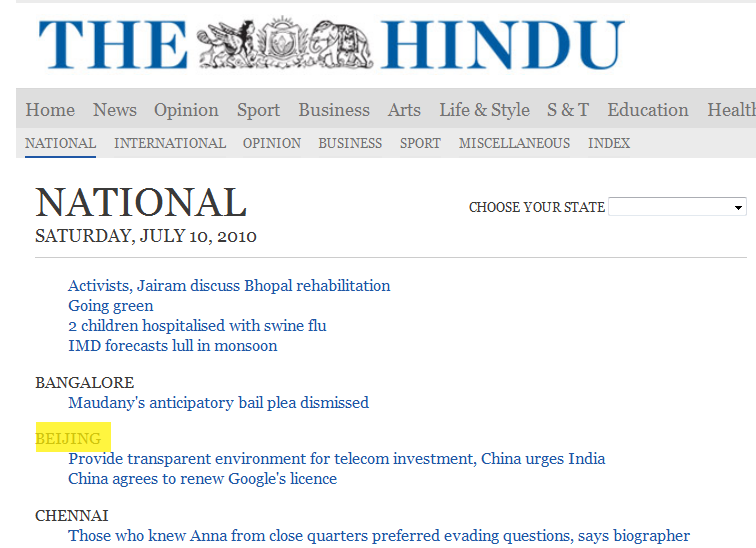
Beijing is national news


When chindu is saying Beijing is national, you begin to wonder which nation it is referring to. At this rate, very soon, I am expecting chindu to say, "We, the Chinese".

Religious indoctrination in Kashmir

This is the kind of honesty and introspection we expect from chindu too. There is no point trying to black out islamic violence or projecting it in some form of non-religious, peaceful protest against some form of marginalisation. The violence in Kashmir or the terrorism perpetrated by LeT, IM, SIMI etc is arising out of an ideology rooted in Islam. We need honesty and courage to acknowledge and fight such dangerous ideologies. At the moment, it appears as if we have fallen into the islamist trap which is keeping the ideology glued to religion.
The Hindu : Today's Paper / OPINION : Kashmir's politicians must act
He sharply criticised those who perpetuated a culture of hate by telling their children they had no future in a “Hindu country.” This is the kind of honesty and introspection needed if a way forward is to be found.

Monday, July 05, 2010

CPI(M)'s terrorist links

It is time to start to calling for a ban on CPI(M).
The Pioneer > Online Edition : >> Cynical politicsweak state
One of the senior-most police officers from the State, Mr Tomin J Thachankary, was found visiting Gulf countries and meeting several fugitives from the law who are wanted for their links to the Indian Mujahideen. ... The police officer has found support from Kerala’s Home Minister Kodiyeri Balakrishnan and CPI(M) State secretary Pinarayi Vijayan.

Britons uneasy with Islam; chindu upset

Hasan Suroor is surprised at the poll findings in Britain on Islam. He uses the opportunity to do some propaganda for Islam and there is always space for such propaganda in chindu. Suroor tells us so much about the bunch of people carefully selected to be the face of Islam. But Suroor avoids telling us is the other side of the story: why do Britons hold such negative attitude towards Islam although it is not evidently visible in public sphere and what could it mean to future of muslims in Britain? May be he could choose a few faces from among the protesters who shouted slogans against the soldiers coming home from Afghanistan.

Dragging in Americans and comparing muslims with other immigrant groups is unbecoming. Such attitude has been the trend in chindu for a while now. In an eagerness to pander to muslim sensitivities, all decorum of decency is being discarded.
The Hindu : Today's Paper / OPINION : British Muslims: countering negative images
But what about Muslims themselves? Have they ever asked themselves why
the whole world appears to be against them? It is a bit like the
Americans who never tire of moaning how everyone is against them but
seldom pause to ask: why?

Indeed, in many ways, they are more culturally integrated than some of the apparently more “secular” immigrant groups.

Sunday, July 04, 2010

Machiavellian theories on terrorism

This article compares chindu and Pioneer articles on Hindutva terror. We did notice how Praveen Swami showed eagerness in propagating speculative theories on hindutva terrorism.

http://cbcnn.blogspot.com/2010/02/praveen-swami-plumbs-depths-of-yellow.html
http://cbcnn.blogspot.com/2010/02/tilak-started-hindutva-terrorism-says.html
http://cbcnn.blogspot.com/2010/04/from-praveen-swami-with-hate.html

(Hat tip: KHR)

Wednesday, June 23, 2010

Who is our PM to interfere between US and Pak?

Is this how our foreign policy is being driven? Manmohan has come up with such ridiculous statements on matters of serious national interest, it is astounding that we only hear of his honesty. You could make fun of Bush's IQ but where it mattered, he was upto the task. Manmohan is a doctorate and has a CV that looks very impressive. But look at some of his statements:
- Who am I to interfere with what goes on between the United States and
Pakistan?
- Muslims have first right to India's resources
- We are harassing the poor Quattrochi
- Losing sleep over Mohd. Haneef, the Indian muslim doctor in Australia

Instead of ripping him apart, N.Ram uses Manmohan's incompetency to come up with a weak defence. This team of politicians and mediamen are taking India to the cleaners.
The Hindu : Today's Paper / OPINION : Don't lose sleep over Chashma
“Who am I to interfere with what goes on between the United States and Pakistan? That's a matter for these two countries to consider,” Prime Minister Manmohan Singh responded in April 2010. The same logic should now apply to reports that China is planning to supply two additional safeguarded nuclear reactors to Pakistan.

S.V. calls for making borders irrelevant

Siddharth Varadarajan seems to have dropped his inhibitions and stepped out of the closet -- he is nakedly espousing a position which has no logical justification and calls it the only option! Disingenuous, stupid, frustrated, conniving or whatever you call it, this is a preposterous position to take. I wonder if Varadarajan, being the American citizen, will ask for U.S. making borders irrelevant with Mexico.
The Hindu : Today's Paper / OPINION : Building trust, one step at a time
The truth is that there are no other cards. The ‘make borders irrelevant' approach is the only game in town and sooner or later all stakeholders in Pakistan will have to be reconciled to it.

The AIT wild ass

Asko Parpola is repaying his debt to the Dravidian party by coming up with more wild ass theories. Its the same old theories on wild asses, missing horses, the Aryans coming on the dot at 1600 BCE to drive the Dravidians down south, the seals, etc. The world has dropped the aryan invasion theory; the migration theorists say the aryans could not have come after 2500 bce and keep pushing the date even further into the past. But chindu keeps promoting such wild asses.
The Hindu : Today's Paper / OPINION : The Indus script and the wild ass
Bones or depictions of the domestic horse and the donkey are not found in South Asia before 1600 BCE. ...the term was transferred to the similar-looking donkey when this newcomer came to South Asia from the west through the Indus Valley.

Sunday, June 20, 2010

Putting Victims at the Centre of Liability Law: A Response to Siddharth Varadarajan

As a follow-up to his first op-ed, Siddharth Varadarajan wrote a second piece in The Hindu. Earlier, I raised some issues in my previous response and post here my thoughts on matters addressed in this later article.

His first point is that “[s]ince the government wants to accede to the IAEA's Convention on Supplementary Compensation (CSC), 300 million SDRs has been chosen as national cap so as to receive compensation from countries that are parties to the CSC beyond that.” My reading of the CSC is different. Art. III(1) of the convention states: “Compensation in respect of nuclear damage per nuclear incident shall be ensured by the following means: (a) the Installation State shall ensure the availability of 300 million SDRs or a greater amount that it may have specified to the Depositary at any time prior to the nuclear incident...” I understand this to mean that 300 million SDR is the minimum amount a state must ensure, not the maximum. The cap amount specified by the GoI in the bill cannot therefore be justified on this ground.

The maximum amount of 300 million SDR available through the CSC (assuming every member of the IAEA joins the convention) probably comes from Ben McRae (Reform of Civil Nuclear Liability, p.176). However, if you use the IAEA calculator and add all IAEA member states, you come up with a figure of ~375 million SDR. I am not sure how he got the figure of 50 million SDR as “the best a member state can hope to receive” but if you add Japan and India to the existing list of member states that have ratified the CSC, you land up with the amount of ~94.2 million SDR. Still it is not a lot which also argues for a higher total cap or no cap at all. I am also unable to see a connection between prohibiting discrimination (between national and cross-border victims of a nuclear accident) in distributing compensation and capping total liability for an incident.

He wants the operator cap to be raised and limited only to public sector operators. Under-provisioning of safety and the prospect of over-optimal share of nuclear power in India’s energy mix are the reasons given in support of this contention. The first has been dealt with before and my explanation in the following paragraph also relates to it. As for the second, the government’s authority to authorize (or deny authorization for) the construction of plants is not in doubt. A low cap as an incentive to build more plants can and surely will be countered by activists highlighting possible hazards and the final outcome will ultimately be guided by political judgment (rather than purely on economic grounds) as to the impact of its pursuit on public support.

He points out that insurance costs only amount to a small percentage of the total cost of the plant and third party liability in any case costs several times less than property insurance which is routinely purchased by nuclear plants around the world without hurting the viability of nuclear power. The issue, as I understand it, has primarily to do with availability. If insurance is not available up to the limit laid down by law, the company would have to make up the difference by setting it aside in bulk which will increase the operating cost. For example, if someone were legally obligated to purchase liability insurance for car accidents for a minimum amount of 1 crore but insurance carriers are only willing to offer coverage up to 10 lakhs, the only way to fulfill the requirement would be by setting aside the sum of 1 crore – 10 lakhs = 90 lakhs of his/her own money which is where it gets expensive (Insurance does not generate assets; it only protects what exists. So, it makes good sense for any business to attempt to keep the expense low). It was primarily this concern of availability that prompted the US Congress to mandate that plants maintain as financial protection “the maximum amount available at reasonable cost and on reasonable terms from private sources” and additionally provide for the state to indemnify them when the Price-Anderson Act was first enacted in 1957.

Insurance carriers are willing to underwrite plant property for amounts much higher than third party liability. Inferring the possibility of raising operators’ cap from the former would therefore be erroneous. The reason for this disparity is not so clear but a general explanation of how the business works would help to understand what factors might contribute to it. Insurance plays a role in a zone which lies between having no knowledge of the probability of an accident and having perfect knowledge of it. In the former instance, any protection offered would entail an unjustifiably high risk; on the contrary, if there was absolute certainty of its occurrence, there would be no point in insuring against it. Operating between these two extremes, insurers utilize various models to estimate the risk involved. These models are usually based on a mix of theoretical and real world data. The more actual data there is, the greater is the confidence with which predictions can be made and vice versa. The maximum amount an insurer is willing to underwrite depends on how much confidence it has in its model. For things like cars and aero planes which crash not infrequently, a fair amount of accident related data is available which gives insurers greater confidence in protecting against such risks and they are willing to cover higher amounts (relatively speaking). Nuclear property damage involves both routine property related risks and those specific to nuclear plants. The former are, likewise, more easily measurable and for the latter, they rely on reports of engineers and experts on the risks associated with particular equipment. Small safety incidents at nuclear plants are not uncommon (often involving non-nuclear damage) and that provides a significant wealth of data enhancing reliability of their predictions. Large nuclear disasters entailing third party liability, on the contrary, have only occurred on a few occasions and a major part of calculations is based on theoretical simulation which leaves them with less confidence about how far such estimates mirror reality. I suppose it is this difference that makes insurers much more wary about underwriting very high amounts for third party liability, a sentiment which would ring stronger in a new market where a priori experience is lacking.

When the Price-Anderson Act was first introduced in the US, private insurers only covered a fairly limited amount of $60 million and the state, in return for a mandatory payment of $30/1000kW from any facility, offered indemnity for an additional $500 million. The amount privately covered grew gradually over time as safety measures ensured that payouts were few and allowed the state to gradually withdraw its own role completely replacing it with a secondary layer of coverage financed entirely by the operators’ themselves, a system that exists to this day (the only differences are in the amount which comes to ~$12.6 billion including both first and second layer of coverage and a third layer was recently added to meet the international obligation under the CSC financed now by suppliers).

Regarding cl.17(b), I have already discussed that the key question is what impact retaining it will have on the willingness of suppliers to participate in the Indian market. Increasing that limit will also likely have a greater adverse effect on smaller suppliers who may prefer to stay away as they would have much more to lose than larger ones who may be able to internalize costs better. Domestic companies may also lose out to their foreign counterparts who, being less readily accessible to Indian law enforcement agencies, may be willing to risk more. If suppliers are made liable for total damages whilst keeping the limit much lower for operators, that too would lead to a moral hazard with operators (rather than suppliers) having a lower incentive to undertake adequate safety measures. This may be more so for state-owned entities owing to the fact that in the event of a disaster, the state, anxious to both deflect blame from itself and to pursue the prospect of obtaining large scale damages from the supplier, may be predisposed to use its control over the investigative machinery to downplay the role of the operator in the incident.

As he says, if India retains cl.17(b), it would have a choice to join the CSC with a reservation or choose to stay out of it. Comparison of this provision with article 4(1) of the South Korean law is not entirely appropriate. Article 4(1) of the South Korean act provides for the operator’s right to recourse “only insofar as there has been a willful act or gross negligence by the supplier of the materials concerned or by his employees” but this is overridden by article 4(2) which states that “If, in the circumstances described in Paragraph 1 of this Article, a special agreement has been made regarding rights of recourse, such agreement shall govern.” Cl.17(b), on the other hand, is distinct and applicable regardless of the operator’s agreement with the supplier under cl.17(a). Thus, the Indian bill is stricter but also, as a consequence, less flexible. Whether that is a good thing or not will depend on how strong the negotiating position of Indian operators will be vis-à-vis suppliers. For example, if the plant operator badly wants something from a supplier who is unwilling to provide it for fear of liability, the Korean law would allow its acquisition by providing a waiver but not its Indian counterpart.

Varadarajan calls for extending the filing period for compensation to 30 years from the present limit of 10 years. The main issue in other countries has been the unwillingness of insurers to offer coverage beyond 10 years. Mark Tetley cites three reasons to explain this reluctance: unwillingness of shareholders to commit to long term risk and uncertain exposure, wariness of second guessing future societal problems in an increasingly litigious climate and uncertainty of the security and solvency of the concerned insurer over such a long period of time. Extending the period is meaningful provided that a way is found to ensure reliability of payout possibly through state support either for all claims beyond an initial 10 year period or perhaps only as a backup.

Involvement of health and environmental experts is not specifically mentioned but the Claims commissioner can seek their assistance under cl.12(2) while holding an inquiry; a similar provision is missing for the commission which is only entitled to the assistance of officers and employees the Center provides as it may deem fit under cl.30(1). This suggestion needs to be considered though the main role of such experts will be in conducting studies and publishing reports in the aftermath of a disaster.

As mentioned in the last post, I cannot see any justification for allowing victims to file civil tort claims in addition to the recourse available under this Act as it duplicates the effort without offering any additional advantages to any concerned party (other than lawyers). I believe the proper answer is to amend cl.46 to preclude this possibility. Providing for judicial review may also be a pragmatic step to take as discussed in an earlier post.

Saturday, June 19, 2010

Propagating a separate Dravidian identity

Chindu has shown more than a fair interest in propagating a separate Dravidian identity, which is in line with the politics of the dominant dravidian parties in Tamilnadu.
The citadels of Aryan invasion have been demolished to rubble. So these eminent Dravidian researchers have come up with Aryan immigration and established it as a "fact". Just like Karunanidhi asked for Ram's engineering degree, we should stand up and ask these Dravidian researchers to show us the immigration visas of these Aryans.
The Hindu : Opinion / Op-Ed : Parpola and the Indus script
He has published a long series of brilliant papers to establish the fact of Aryan immigration into South Asia after the decline of the Indus Civilisation.

Tuesday, June 15, 2010

Turning the Nuclear Bill from Liability to Asset: A Response to Siddharth Varadarajan

Siddharth Varadarajan’s op-ed today in The Hindu about why the nuclear liability bill is flawed is a familiar theme. I have addressed most of these points in an earlier post and will not repeat them again here. It suffices to mention that I explained there why legal channeling makes more sense than economic channeling, what the basis for operators’ liability cap amount is (or at the very least, ought to be assuming the GoI is doing it according to the rationale) and what the issues with the operators’ right to recourse under section 17(b) are. What follows is a short follow-up to that post.

It is true that the entire nuclear liability regime began as an attempt to protect the American nuclear manufacturers from foreign liability. The regime, however, does not distinguish between Americans and others and as it stands today, protects suppliers from all countries with membership in any of the liability conventions. That includes India’s own domestic industry which is expected to play an important role in building nuclear power plants. It is not surprising then that this group is strongly supportive of the bill and efforts to exclude suppliers from liability.

It is obvious that section 17(b) does not alter the rights of victims of the disaster; there are several reasons to doubt whether it will offer any benefit to consumers/tax payers either despite the explicit provision to collect for damages from the supplier. Firstly, in the event of such a provision being passed by parliament, it is extremely doubtful that any supplier will venture into the business without insurance cover at the risk of losing all of its assets. So, if we assume that arrangements are worked out amongst suppliers and possibly including operators, the next question is whether such an arrangement will add assets which would not be available were operators alone to purchase it (otherwise, there is no advantage at all: operators pay for the insurance instead of suppliers or both do so having entered into a mutual arrangement but regardless of who purchases it, the assets remain the same, total amount up to the cap is covered and will be paid out to third parties in the event of an incident). The answer to that is probably in the negative given how insurance systems work. Nuclear insurance pools are mostly regional or countrywide, not global (barring very limited global coverage offered in some instances such as the $50 million by ANI). Also, even if some Indian company specialized in a different line of business such as making automobile parts and insured against tort damages decides to venture into supplying parts for nuclear plants, the much higher damages involved will entail a much greater risk which will likely prevent coverage from being extended to its nuclear manufacturing arm. Thus, the insurance asset pool is not going to expand merely by bringing suppliers within the ambit of the law – in fact, the heightened risk may very well serve to incentivize the opposite - which begs the question why it is needed at all.

Varadarajan wants section 17(b) to stay along with the removal of the operators’ cap which means full liability or at least up to 300 million SDR for operators. As explicated in the previous post, the question is what that will do to the operating cost of the plant and in consequence, to the consumer/tax payer who has to bear the burden of the increased cost of electricity/subsidy. My guess: it will be beyond the ability of the consumer or the state government to purchase it and the enterprise might well turn into another Enron type of disaster. The article is silent on this question.

As mentioned in the previous post, capping liability to operators and suppliers does distort the true cost of running the plant but not doing so, it is feared, will render the effort prohibitively expensive and impractical. Properly enforced regulations are partly the answer but critics would argue that this is not adequate. Besides rhetoric, the author offers no solution to this conundrum. The optimal solution I can think of is a compromise where liability limits are capped at low levels initially but are gradually raised as the industry grows out of its infancy and its capacity is increased. History of the US Price Anderson Act and nuclear liability legislation in several other countries suggests that this may be a feasible course for India to follow as well.

Lastly, the whole point of strict liability and the separate mechanism for adjudicating claims is to allow victims to obtain compensation without having to meet the higher standard of tort law. If victims are free to pursue tort remedies in addition to this, it raises the question whether the caps and channeling requirements laid down by this law are meaningful at all. If extended litigation in courts is not preempted and the prospect of unspecified damages having to be paid looms large over the heads of operators and suppliers, it is entirely possible that the purpose of this law will stand completely defeated. This is an important concern and a strong case therefore exists to amend this provision to preclude such a possibility if the GoI is intent on creating a workable arrangement to develop the nuclear industry.

The bottom line is that the purpose of this legislation will not be fulfilled unless hard compromises are made. The question is whether the government has the courage to do so or would rather give in to populist impulses and end up passing a version too diluted to make meaningful change possible.

N.Ram sees inflationary threat in free trade

Whereas UPA's handouts and ill-designed schemes are causing inflation, N.Ram thinks free market caused it and socialism is the solution to inflation. Given a chance, N.Ram would push India back to the Nehruvian-Stalinist era of government control over every aspect of our lives. While advocating socialism to the others, he clings on dearly to his position in chindu, standing up for capitalism in his personal life. There are no better hypocrites than the darn communists.
The Hindu : Opinion / Editorials : Double-digit inflation
Finally, inflation is high and persistent, despite expectations of a normal or good monsoon, because the decision to give private trade a greater role in the markets for essentials has provided the basis for a new bout of speculation

Friday, June 11, 2010

US/NATO exit from Afghanistan Spells Danger for India

The Hindu editorialized a few days ago that the only answer in Afghanistan is for the US and other NATO troops to leave. The paper has been pushing the line that a conference must be held where all parties will promise not to interfere in Afghanistan's internal affairs and peace will thus be restored. Most readers will probably realize that this is just another pacifist pipedream. It needs no repetition that Pakistan's promises cannot be taken seriously particularly when proxies are in abundant supply to faithfully carry out its wishes. Pakistan's willingness to utilize them is also not in doubt and with foreign troops gone and no one to enforce such promises, it should be obvious that the altered political scenario will quickly render such conference pronouncements worthless. The US may have less to fear from such an eventuality given that Pakistan has long been willing to extend guarantees to use its influence with the Taliban to prevent any attack upon it but India of course will receive no such guarantee and with a resurgent Taliban under Pakistani influence, it has much cause for concern. By blindly echoing American liberals, The Hindu's views thus dovetail very well with Pakistani strategy but offer little succour for Indian interests in the region.

Today the NYT reports that Karzai is losing faith in the ability of foreign troops to sustain his government and doubts their resolve and willingness to stay. India has to take note of it in deciding how to hedge its bets as the situation evolves. Though Obama has proclaimed that a withdrawal will begin in 2011, the seriousness of this proposal is in some doubt given previous pronouncements of officials of his cabinet. One thing is however quite clear: India's difficulties will multiply very quickly were the US/NATO troops to leave precipitously. Pakistan's jihadi network has had an important role in protecting and aiding the senior Taliban leadership during their most difficult years in the political wilderness. Whatever else may be said of the senior Taliban leadership, there is little doubt that these are men of honor who value loyalty and camaraderie more than anything else and any carrots that India may be belatedly able to offer them in terms of financial aid or expert assistance to counteract it may not hold much appetite for them. American withdrawal may thus be expected to quickly restore the pre-9/11 situation which means a renewed and resurgent terrorist onslaught against not just Kashmir but all of India. The difference will be that this time, apart from a fresh crop of battle hardened fighters to train and guide insurgents, there will also be the added motivation that having overcome the world's mightiest nation, defeating India would not be an impossible task.

India has much at stake and a lot of reasons to persuade the US and its alllies not to leave Afghanistan any time soon. If India's left has its way, we may be inviting trouble more quickly than we realize.

Sunday, June 06, 2010

UPA's reckless spending

Sadly, UPA, under the "eminent economist and honest PM", is creating havoc with disastrous fiscal policies. High fiscal deficit is pegging interest rates at uncomfortable levels. Unlike manufacturing and services, agriculture is unlikely to experience blistering growth rates. But what really hurt the agriculture sector is government intervention by way of populist schemes. Through doles via schemes like NREGS, UPA created artificial wage inflation in rural areas. It peeled peoples off the land and clung them onto the mammaries of the state.

UPA's fiscal policies are not creating assets or building infrastructure. Government allocation is creating and feeding inefficiencies
within the system, while increasing income disparities. UPA-1 has already pushed 100 million Indians into poverty. All indications are that UPA-2 is accelerating the pace of perpetrating penury.

The Pioneer > Online Edition : >> Growth for some handout for many
The total fiscal deficit (the Central Government plus the states) is nearly 10 per cent of the GDP.
... manufacturing grew by 9.3 per cent last year and services by 8.5 per cent. By contrast, agriculture, which still sustains some 60 per cent of the population, struggled to experience a 0.2 per cent growth.

Thursday, June 03, 2010

Varadarajan burdened by journalistic debt

This journalistic debt that he talks about, Siddharth Varadarajan feels only when it comes to muslims. Varadarajan is faking a sense of morality by claiming to be burdened by this journalistic debt.  Why doesn't he put some effort to write a few stories on Kashmiri
pandits. He is probably afraid of the enormity of the secular debt that it will accumulate. That is not kosher, is it.
The Hindu : Opinion / Leader Page Articles : This is not zero tolerance, Mr. Prime Minister
My question to Dr. Singh, then, was really Raja Begum's, the partial discharge of a debt journalists accumulate as they run from story to story.

Wednesday, June 02, 2010

The enemy within

The kind of strategic intent that America is displaying to protect its interests and the safety of its citizens is precisely what India should be emulating. Instead, N.Ram suggests that America should follow the miserably failed policies of New Delhi although it has not yielded any results over the past few decades. It is N.Ram who needs to clear his vision and stop jumping to conclusions based on blind love for islamists and hatred for capitalists.
The Hindu : Opinion / Editorials : The enemy within
A military strike by the U.S. on Pakistan, reported to be under contemplation should a terrorist attack on American soil succeed, is no solution. Any such action would be extremely foolhardy, and New Delhi should oppose it.

N.Ram enraged at Israel

The Hindu : Opinion / Editorials : Israel's rogue behaviour
Gaza: unarmed, humanitarian flotilla of activists, relief supplies, a Gandhian act of solidarity, besieged and blockaded people of Gaza, suffers all the evils of occupation, blockade of Gaza and its people, collective punishment of civilians, subjecting an entire civilian population to an economic blockade

Israel: rogue behaviour, lawless, outlaw nature, used grossly disproportionate force, criminal Israeli response, illegal and immoral blockade of Gaza, a pretext for the blockade (of Gaza), a full-scale war on the people of the territory(Gaza), Israeli invasion of 2008-09 led to the commission of war crimes
N.Ram clearly draws the battle lines and uses imagery to conjure up an image of an illegal occupier tormenting a hapless victim. Such vivid description is more apt for Tibet under Chinese occupation.

For a different perspective on the matter, have a look at Kanchan Gupta's blog post or B.Raman's take on this. Bulk of international response opposed Israel's methods but recognized the provocation. Even ardent supporters of Israel thought the matter could have been resolved differently. But N.Ram's depiction seems to be overboard. Or may be he is just singing for his supper.